


Biopharma leaders are being asked to do something that is directionally clear but operationally complex: Reshore manufacturing, reduce dependency on overseas production, and strengthen supply chain resilience.
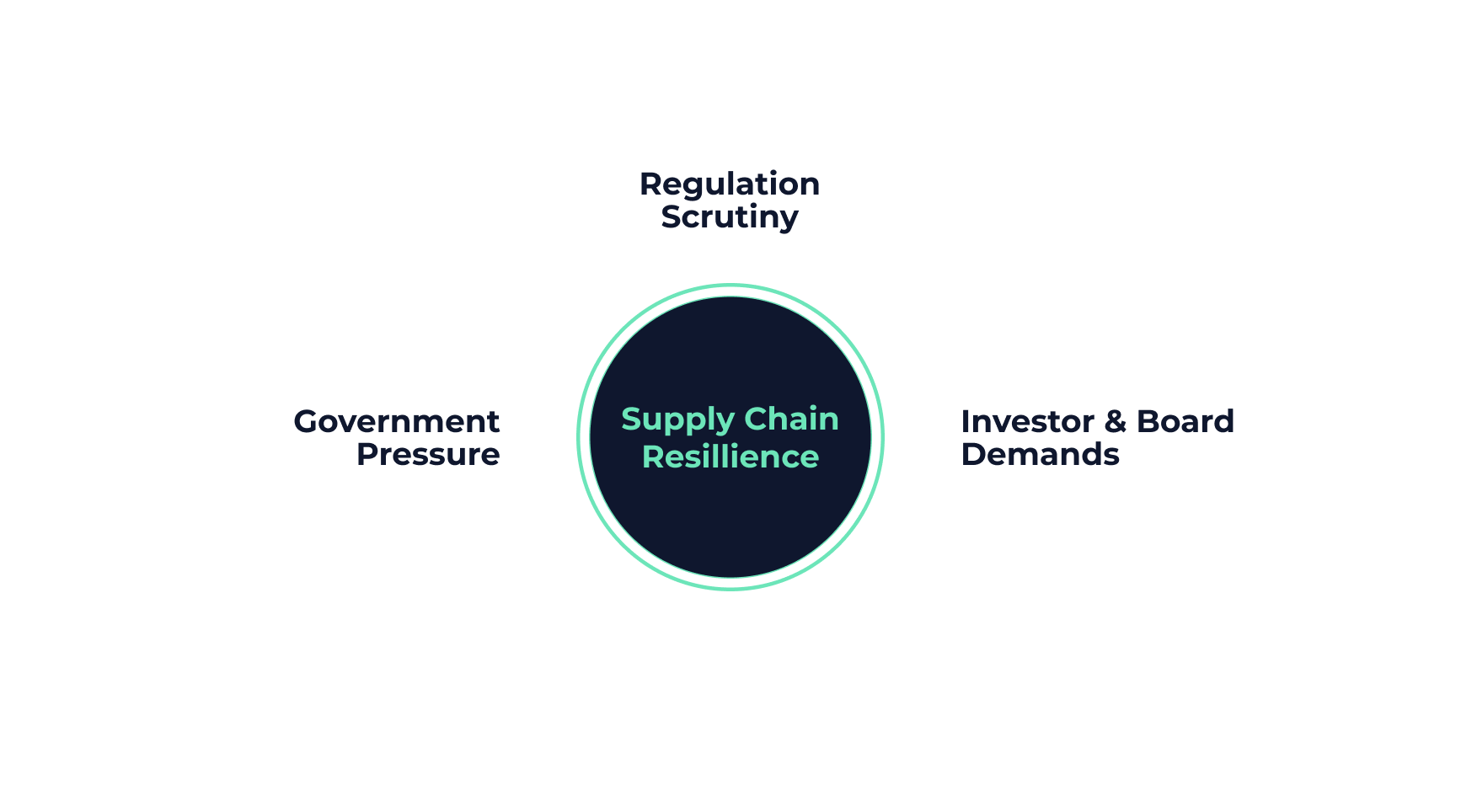
That pressure is coming from multiple directions.
Governments are pushing for domestic manufacturing through policy and funding. Regulators are increasing scrutiny on supply chain transparency and reliability. Investors and boards are prioritizing risk reduction following years of disruption tied to geopolitics, COVID-era volatility and concentration in key regions.
On paper, the mandate is straightforward.
The problem is execution.
The U.S. manufacturing ecosystem organizations are being pushed toward is constrained. Capacity is limited, qualified capability is uneven and the workforce is not scaled to absorb demand at the pace required.
That tension is defining external manufacturing right now. Leaders are still optimizing, but they are doing so within tighter constraints, where tradeoffs are more explicit and margin for error is smaller.
The Mandate Is Clear. The Tradeoffs Are Not.
Across much of the industry, the pressure centers on a few themes:
- Increasing domestic manufacturing presence
- Reducing reliance on single-region supply chains
- Improving resilience against disruption
These goals are aimed at improving supply continuity, reducing geopolitical exposure, and increasing regulatory confidence.
But inside operating teams, the reality is more constrained.
Reshoring assumes available, qualified capacity exists. In many cases, it does not. The issue is not that there is nowhere to go. It is that capacity may not be available when needed, at the right cost, or at the level of regulatory and technical readiness required.
That distinction matters.
The Illusion of Choice in External Manufacturing
There is a persistent narrative from boards, investors, and advisors that companies can shift their external manufacturing strategies by:
- Moving away from China
- Diversifying suppliers
- Rebalancing geographically
In practice, that flexibility is limited.
For many organizations, particularly emerging biotech companies, Chinese manufacturing remains foundational due to cost structure, speed and established capabilities. Moving away from that model does not automatically reduce risk. It can introduce new risks, including higher costs, longer timelines and increased execution complexity.
Even for larger organizations, diversification runs into practical limits:
- Alternative capacity is constrained
- Lead times are long
- Switching costs are significant
External manufacturing is not a blank slate. It is a constrained system where choices are shaped by availability, timing and feasibility.
The Capacity Constraint Is Structural
If reshoring is the goal, capacity is the first barrier.
Critical capabilities across the U.S. are already heavily utilized:
- Sterile fill-finish capacity is often booked out months to over a year
- Advanced modalities such as ADCs, and cell and gene therapy have a limited number of viable partners with custom technology
- Specialized delivery systems such as pre-filled syringes and auto-injectors offer few options
This creates a different operating reality than many high-level supply chain strategies assume.
Organizations are not selecting the best partner in an open market. They are competing for access to constrained resources. Once that access is secured, flexibility becomes limited. Timelines are influenced more by availability than by internal intent.
Resilience, in this environment, is built by navigating scarcity rather than avoiding it.
It’s Not Just Capacity. It’s Qualified Capability
Capacity alone is not the issue. The real constraint is qualified capacity.
A facility may have available slots on paper. But if it lacks the systems, digital infrastructure, regulatory maturity or modality-specific experience required, that capacity is not truly usable.
This is where gaps emerge between:
- What modern manufacturing requires
- What some facilities are equipped to deliver
Examples include:
- Manual or hybrid quality systems that slow deviation management
- Limited digital infrastructure for real-time visibility
- Inconsistent adoption of automation technologies
- Gaps in experience with emerging modalities
These are not just operational challenges. They directly affect execution quality and increase the likelihood of issues surfacing under regulatory scrutiny.

The question is not whether capacity exists. It is whether qualified, inspection-ready capacity exists for the product and timeline required.
The Constraint Behind the Constraint: Talent
Facilities tend to dominate external manufacturing conversations. But another constraint is becoming harder to ignore: talent.
Not just headcount. Experience in critical roles.
This shows up across specific functions:
- Process engineers and development staff, where hiring gaps are already well documented
- Tech transfer leaders, who translate development into scalable manufacturing
- Quality and regulatory leaders, who ensure decisions hold up under inspection
- Program and operations leads, who coordinate timelines, partners and execution
Several dynamics are compounding the issue:
- Lack of real-world experience across multiple companies
- Workforce mobility has increased, reducing continuity within teams
- Deep expertise remains concentrated in a small number of individuals

In specialized areas such as cell and gene therapy, ADCs, and complex biologics, the gap between baseline capability and real experience is, frankly, enormous.
That creates a compounding constraint across capacity, capability, and execution. Limited capacity, uneven capability and concentrated experience reinforce each other, making external manufacturing decisions more sensitive to who is involved and how decisions are made.
Why Traditional Risk Mitigation Breaks Down
The standard playbook for external manufacturing risk includes:
- Dual sourcing
- Backup suppliers
- Geographic diversification
In theory, these approaches are sound. In practice, they carry real cost and complexity:
- Tech transfers that can take months or longer and require significant investment
- Additional validation and comparability work – ‘How close is close enough?’
- Increased operational and governance complexity
For many organizations, especially smaller ones, full redundancy is not feasible or affordable.
This leads to a more practical reality. External manufacturing risk is rarely eliminated. It is reduced where possible, transferred where practical and, in some cases, tacitly accepted.
The focus shifts from reacting to risk to preparing for it, with clear ownership, governance and contingency planning in place before issues arise.
The Real Shift: Visibility and Governance
One of the more meaningful changes is internal.
In more complex or mature organizations, external manufacturing is receiving greater executive visibility and more formal governance. It is no longer treated solely as a procurement or vendor management function.
This shift shows up in a few ways:
- Decisions involve technical, regulatory, financial and operational stakeholders earlier
- Governance structures are defined and formalized
- Tradeoffs are evaluated in terms of business impact, not just cost
The change is not that these functions were once purely transactional. It is that the level of coordination, visibility and accountability around them is increasing.
Organizations that navigate this well are not necessarily better negotiators. They are better at managing complexity across functions.
Where Organizations Still Struggle
Despite this shift, alignment remains a consistent challenge.
The issue is not that leadership is unaware of risk. It is that external manufacturing complexity is not always translated into business impact, timing risk, and decision-ready tradeoffs early enough.
In many organizations:
- Technical and supply risks are not clearly framed in business terms
- Cross-functional governance is inconsistent
- Procurement-led processes may lack sufficient CMC or regulatory context
This leads to predictable outcomes:
- Expectations that do not match operational reality
- Timelines that are not grounded in actual constraints
- Decisions that optimize for cost but introduce downstream risk
The challenge is not just the supply chain itself. It is how decisions about that supply chain are structured, communicated and governed.
What This Means for Leaders
For executives navigating this environment, success is not about eliminating constraints. It is about operating effectively within them.
That requires a shift in focus:
Recognizing system limits
Not every product can be fully de-risked. Early-stage programs, highly specialized modalities, and time-sensitive launches are more likely to operate within tighter constraints.
Prioritizing critical programs
Resources and attention need to be directed toward the highest-value assets and the most sensitive failure points.
Strengthening decision capability
This includes investing in experienced people, clearer governance, stronger technical oversight, and better cross-functional escalation.
Balancing contracts and relationships
Quality agreements, governance terms, and accountability structures matter. But alignment and responsiveness also matter when issues arise, deviations occur, or priorities shift.
A More Practical Definition of Control
It is tempting to treat control as ownership: Build internally, localize manufacturing, and reduce external dependence.
In some cases, those approaches help. But ownership does not guarantee control. Internal manufacturing can still face capacity limits, capability gaps, and execution challenges.
In external manufacturing, control is defined differently.
It comes from:
- Understanding where exposure exists
- Defining clear decision rights and governance
- Selecting partners with the right capability, expertise, and experience
- Maintaining the ability to respond when conditions change
Control is not about eliminating reliance on external partners. It is about operating effectively within a system that includes them.
Ready to Navigate External Manufacturing Risk with Confidence?
External manufacturing decisions do not fail on paper. They fail in execution.
Reliant Life Sciences supports pharma, biopharma, and medical device organizations with execution-ready talent across:
- CMC and external manufacturing strategy
- Supplier and CDMO management
- Quality and external manufacturing Quality
- Validation
- Tech transfer and scale-up
- Regulatory strategy and operations
Talk to a Reliant Life Sciences expert to discuss how your organization can better navigate external manufacturing risk and make confident decisions under pressure.