


Talk to ten staffing owners about payroll and you will hear the same three sentences. “Payroll takes too long every week.” “We had a contractor get paid wrong again.” “I think we need new software.”
That last sentence is almost always wrong. New software doesn’t fix payroll problems in staffing. Process does. Most of the firms we work with came in convinced they needed a system upgrade and left with the same software, a clean weekly workflow, and back-office hours cut in half.
This guide is for staffing owners who are tired of payroll being the most stressful part of every Friday. According to the U.S. Bureau of Labor Statistics, the temporary help services industry employs millions of workers across the country, and almost all of them get paid weekly. The mechanics of doing that well are not obvious if you have not lived inside a staffing firm. We will walk through what staffing payroll actually involves, the five mistakes that cost firms real money, the workflow that prevents most of them, and how to decide whether you should keep payroll in-house or hand it to a specialist.
Key Takeaways
- Most staffing payroll problems are process problems, not software problems. New software won’t fix a broken timecard workflow.
- The five mistakes that cost staffing firms the most money: worker misclassification, missed multi-state registrations, wrong workers’ comp codes, manual timecard entry, and late federal deposits.
- Weekly payroll is non-negotiable in staffing. Switching to bi-weekly to save effort almost always costs more than it saves through contractor turnover.
- For firms between $5M and $50M, outsourcing payroll to a staffing-specialized accounting team typically costs less than one full-time payroll specialist and removes the entire compliance risk surface.
Why Staffing Payroll Is Its Own Discipline
Generic payroll advice does not survive contact with a staffing firm. Five things make staffing payroll structurally harder than payroll for almost any other business.
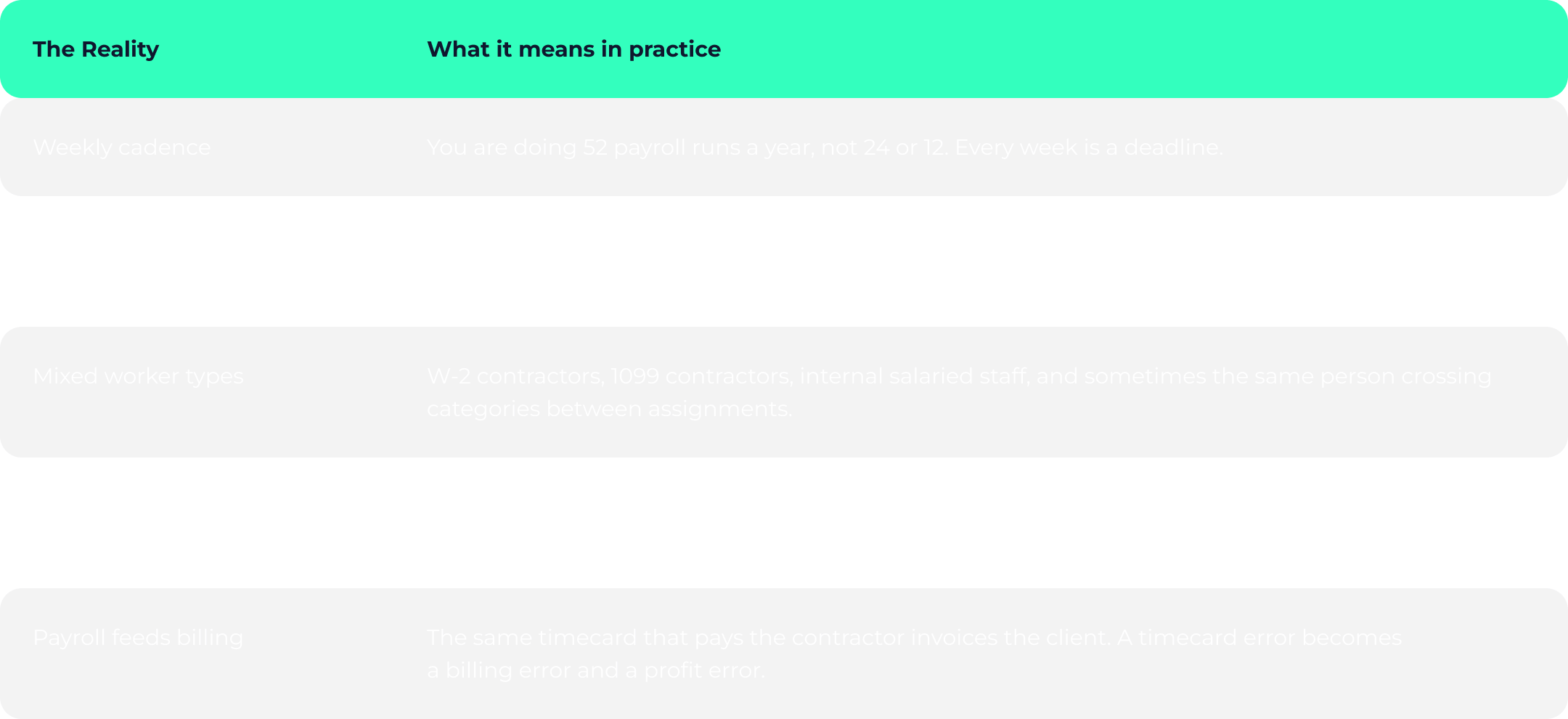
Each of these on its own is manageable. Together, they create a compounding problem: a single missed timecard on Tuesday means an underpaid contractor on Friday, an under-billed client on the next invoice, and a downstream issue in your monthly margin report. A regular small business never sees this problem. A staffing firm sees it every week.
The Five Most Expensive Payroll Mistakes Staffing Firms Make
Almost every payroll problem we see at established staffing firms comes down to one of these five issues. Each one is preventable. Each one, left unaddressed, can cost a $10M firm tens of thousands of dollars in a year, and a $30M firm well into the six figures.
1. Worker misclassification (W-2 vs. 1099)
Staffing firms classify workers as 1099 contractors more often than they should, usually to avoid employer-side payroll taxes and benefits costs. The problem is that the IRS guidance on worker classification applies a strict three-part test (behavioral control, financial control, relationship of the parties), and most staffing arrangements fail it. If you control where the contractor works, when they work, and how they work, they are almost certainly a W-2 employee in the eyes of the IRS regardless of what your contract says.
The cost of getting this wrong: back federal income tax withholding, back FICA (both the employer and employee shares), federal and state unemployment, workers’ comp premiums, and penalties. Calculated back several years. For one misclassified person at a typical hourly rate, the exposure can hit $15,000 to $25,000. Multiply by your contractor base.
2. Missed multi-state payroll tax registrations
If you place a contractor at a client site in a state where you are not registered for payroll tax withholding and unemployment insurance, you are out of compliance from the day that contractor starts work. Most generic accountants do not track this. The first sign is usually a notice in the mail from a state department of revenue, by which point you owe back filings, interest, and penalties for every quarter you missed.
This problem scales linearly with growth. A firm operating in two states is manageable. A firm in eight states without a tracking process is one growth quarter away from a multi-state mess.
3. Workers’ compensation class code errors
Workers’ comp premiums are calculated by class code. Code 8810 (clerical office) costs maybe $0.30 per $100 of wages. Code 5403 (carpentry construction) can cost $15 or more per $100. The same contractor doing two different assignments can fall into completely different class codes. If you default everyone to one code, you are either overpaying premiums by tens of thousands a year, or underpaying and waiting for an audit.
This is one of the easiest things for a staffing-specialized payroll team to get right and one of the easiest for a generic payroll team to get wrong.
4. Manual timecard entry
If your team is keying timecards from email, PDF, or paper into a payroll system every Thursday night, you are paying for that twice. Once in labor cost and once in error rate. Manual entry is the single biggest source of payroll mistakes in staffing firms, and it is almost always a process problem rather than a software problem. The fix is not always a new ATS. Sometimes it is a clean handoff between an existing ATS (Bullhorn, TempWorks, Avionté) and an existing back office through a properly configured integration.
5. Late or wrong federal payroll tax deposits
Federal payroll tax deposits are not flexible. The IRS deposit schedules assign you to either a monthly or semi-weekly schedule based on your prior-year tax liability, and miss the deadline by even a day and you owe an automatic penalty (2 percent for one to five days late, escalating to 15 percent at the high end). On a $50,000 deposit that’s a $1,000 to $7,500 hit. For larger firms, a missed semi-weekly deposit on a six-figure payroll can trigger a same-day banking failure plus the penalty.
All of this is documented in IRS Publication 15 (Circular E), which every employer is technically responsible for following. Most staffing owners have never opened it. Their CPA is supposed to. A staffing-specialized CPA will.
What a Clean Weekly Payroll Workflow Looks Like
Here is the actual sequence a well-run staffing firm follows every week. The names of the days will vary based on your pay date, but the structure is the same.
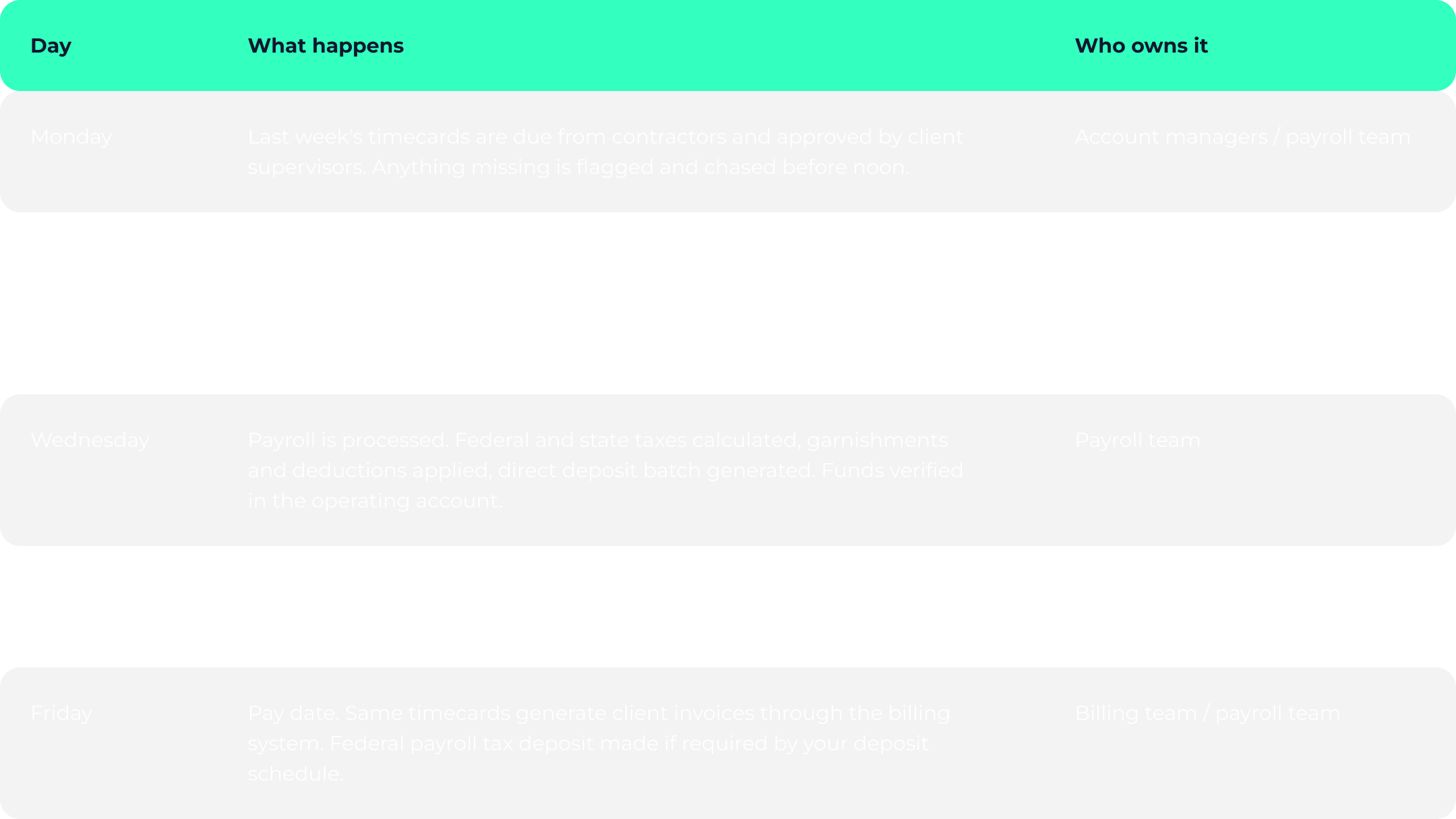
Two things make this workflow possible. First, integration between the ATS and the payroll system so timecard data does not have to be re-keyed. Second, clear ownership at every step so nothing falls through. Most staffing firms have neither.
The Compliance Backbone Underneath the Workflow
A clean weekly workflow only works if the underlying compliance machinery is in place. Three federal compliance areas matter most for staffing payroll.
Federal employment tax obligations
Every staffing firm with W-2 employees is responsible for withholding federal income tax, Social Security and Medicare (FICA), and depositing the employer portion of those taxes plus federal unemployment (FUTA). The full set of federal employment tax responsibilities is laid out by the IRS, but the practical implication for staffing firms is that you need to know your deposit schedule (monthly or semi-weekly), file Form 941 quarterly, and reconcile to W-2s annually. A missed Form 941 filing is a $200 to $500 penalty per month it stays late, plus interest.
FLSA compliance
The Fair Labor Standards Act governs minimum wage, overtime, and recordkeeping. For staffing firms, the most common FLSA issue is overtime calculation when a contractor works for two different clients in the same week. The hours combine for overtime purposes. If the contractor works 30 hours at Client A and 15 hours at Client B in the same week, the last 5 hours are overtime regardless of how the time is split between clients. Generic payroll systems do not always handle this correctly.
Recordkeeping requirements
Per DOL Fact Sheet #21, payroll records must be retained for at least three years, and the supporting time and wage records (timecards, schedules, wage rate tables) for at least two years. For staffing firms with high contractor turnover, this means a record-retention process that can survive contractors leaving, ATS migrations, and software upgrades. The records have to be accessible for inspection by the DOL on request. “Our old system is gone” is not a defense.
When Software Actually Is the Problem
Most of the time, the solution to payroll pain is process, not software. But sometimes software really is the bottleneck. Here is how to tell the difference.
Process problem signals: Timecards arrive late. Approvals get bottlenecked at one person. The same errors repeat every week. Payroll runs require manual reconciliation between two systems that should talk to each other. Staff turnover causes payroll to break.
Software problem signals: Your payroll system literally cannot handle multi-state withholding. Your ATS does not export timecards in any format your payroll system can consume. You have grown past the QuickBooks Desktop user limit. Your software vendor has discontinued the version you are on. Reporting that takes you hours could be a one-click report in a modern system.
If you are diagnosing a software problem, talk to a staffing-specialized accounting team before you talk to a software vendor. We have seen too many firms spend $50K and six months migrating to a “better” system that did not solve the underlying issue. Payroll for staffing firms handled correctly often means staying on the system you have, with a cleaner process running on top of it.
In-House vs. Outsourced Payroll for Staffing Firms
There is no universal answer here either, but the framework is clearer than for general accounting.
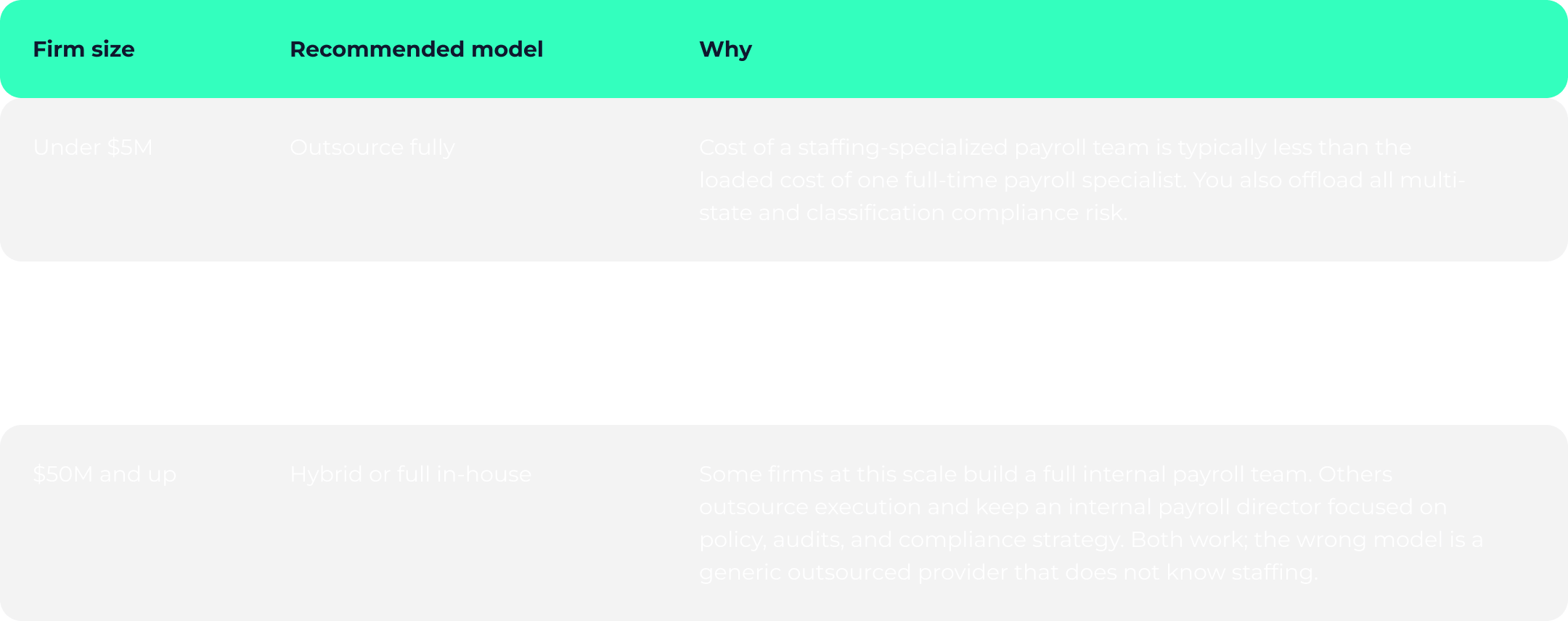
The key distinction is not in-house versus outsourced. It is staffing-specialized versus generic. A generic outsourced payroll provider (think the big national brands) will run your payroll on time, but they will not catch a workers’ comp class code error, will not know to flag a multi-state nexus issue, and will not integrate cleanly with your ATS. A staffing-specialized team does all of that as a matter of course. For most growing firms, billing services for staffing firms and payroll go to the same team for exactly this reason.
Signs Your Current Payroll Setup Needs to Change
If three or more of these describe your firm, you are paying the cost of broken payroll already. You just are not seeing it on a single line item.
- Payroll consistently takes more than one full day a week to process.
- You have had at least one contractor paid incorrectly in the past 90 days.
- You have received a payroll tax notice from the IRS or any state agency in the past 18 months.
- Your timecards are still being entered manually anywhere in the workflow.
- You can’t tell, without asking your accountant, whether you are on a monthly or semi-weekly federal deposit schedule.
- You are not 100 percent sure you are registered for payroll tax in every state where your contractors currently work.
- Your payroll provider has never asked about your workers’ comp class codes.
- You are using the same payroll system you used when you were half your current size.
The Bottom Line
Streamlining payroll in a staffing firm is rarely about the software. It is about owning the workflow end-to-end, classifying workers correctly, registering in every state where you operate, integrating timecard data instead of re-keying it, and never missing a federal deposit deadline. Get those right and the rest is mechanical.
If you would rather not be the person responsible for any of that, that is what we do. RLP runs payroll for staffing firms every week. We know the systems, the deadlines, the class codes, and the classification tests. We integrate with your ATS instead of fighting it. Meet the team behind RLP or see what working with RLP looks like. When you are ready, talk to our team.
Frequently Asked Questions
What makes payroll for a staffing firm different from regular business payroll?
Staffing payroll runs weekly instead of bi-weekly or monthly, processes timecards from dozens or hundreds of contractors at multiple client sites, handles a mix of W-2 and 1099 workers, deals with multi-state withholding because contractors often work across state lines, and ties directly to client billing through markup calculations. A single missed timecard or wrong rate flows downstream into both an underpaid contractor and an under-billed invoice.
What are the most common payroll mistakes staffing firms make?
The five most expensive mistakes are: misclassifying workers as 1099 when they should be W-2, missing multi-state payroll tax registrations, using the wrong workers’ compensation class code, processing timecards manually instead of integrating ATS and payroll systems, and missing federal payroll tax deposit deadlines. Any one of these can cost a mid-sized staffing firm tens of thousands of dollars per year.
Should staffing firms outsource payroll or run it in-house?
For most staffing firms between $5M and $50M in revenue, outsourcing payroll to a staffing-specialized accounting firm is more cost-effective than building it in-house. The cost is usually less than one full-time payroll specialist, and you get a team that already knows how to handle timecards, multi-state filings, contractor classification, and ATS integration. In-house payroll only makes sense at a larger scale or when you have very unusual requirements.
How often should a staffing firm run payroll?
Weekly payroll is the industry standard for staffing firms. Contractors expect weekly pay because that is how the rest of the industry operates, and switching to bi-weekly or monthly typically hurts contractor retention. Some firms run a hybrid: weekly for hourly contractors, bi-weekly for salaried internal staff. The key is consistency and reliability. Late or wrong paychecks are the fastest way to lose your contractor base.