


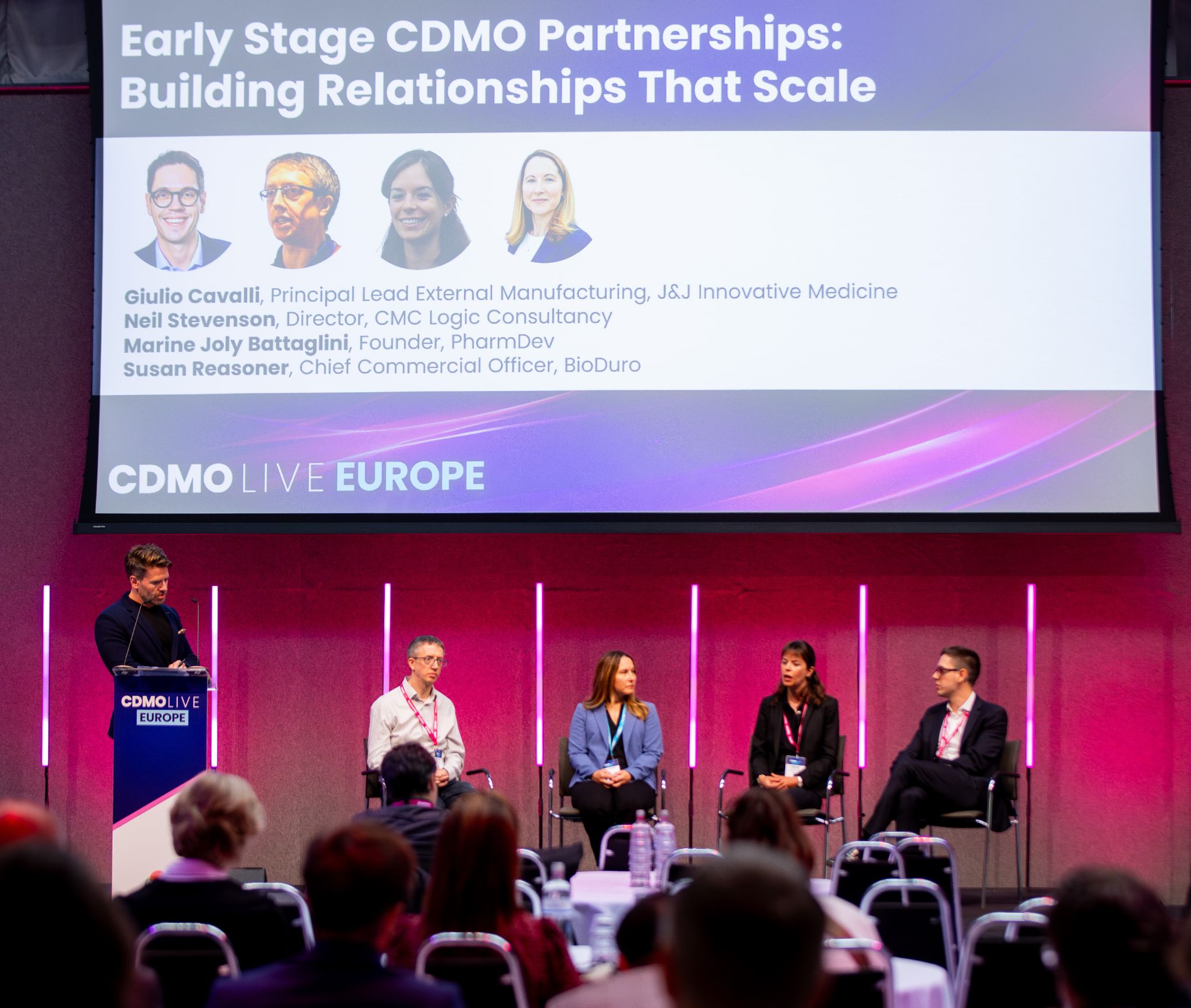
Last month, I attended two events focused on different parts of the pharmaceutical landscape: CDMO Live in Rotterdam and Pharmacovigilance USA in Boston.
The conversations ranged from supply chain resilience and outsourcing partnerships to patient safety and agentic AI. But the same question kept surfacing in different forms: Where should technology and process end. And then where should human judgment begin?
That question matters across the product lifecycle.
Sure, you can have a company that can build a detailed sourcing framework, deploy advanced analytical tools, and automate parts of a safety workflow. Yet none of those steps removes the need for trust, clear accountability, shared priorities, and experienced people whose job is to make difficult decisions.
Strategic partnerships need more than a label
At CDMO Live, there was broad agreement that strategic partnerships matter. There was far less agreement about what a strategic partnership looks like in practice.
That gap is quite revealing.
Biopharma companies and CDMOs often enter relationships with the same stated ambitions. They all want transparency, flexibility, reliable delivery, and long-term value, but yet shared language does not guarantee shared expectations.
Simon-Kucher presented research showing goal alignment between established or emerging biopharma companies and late-stage CDMOs ranging from 77% to 82%. Yes, those numbers sound encouraging. Though they still leave meaningful room for friction.
As the presenters put it, “Wanting a strategic partnership and building one are two different things.” They made a second point that deserves attention: “One-size-fits-all communication and collaboration strategy will not work.”
A partnership does not become strategic because both parties use the word. No, it becomes strategic when teams define how decisions will be made, how problems will be escalated, and ruthlessly prioritizing which outcomes carry the most weight. It requires clarity around risk, cost, speed, quality, capacity, and patient impact.
Different products need different operating models. A mature commercial therapy cannot be managed in the same way as an emerging program with uncertain demand. A relationship spanning several sites and regions creates another layer of complexity.
Supply chain resilience requires sharper choices
Risk management was another central theme in Rotterdam. We know that supply chain resilience remains a major priority for pharmaceutical companies. Yet resilience does not mean eliminating every possible risk. In fact, that would be expensive, slow, and quite unrealistic.
Sandoz shared an example of a risk-adjusted, value-based decision framework that begins with patient criticality. From there, the company considers factors such as regional exposure, market importance, commercial value, and the number of competitors. This is an approach which turns resilience into a sequence of choices – rather than a blanket policy.
Dual sourcing often appears to be the obvious answer (it’s common in business continuity planning). In practice, adding a second source does not solve every vulnerability. It can introduce new costs, technical transfer work, quality oversight, and operational complexity.
The soft science is often the hardest part
At CDMO Live, I also spoke about partnerships across sites, regions, and geographies.
It’s well-known that technical capability is essential. Success is often dependent on this. Teams need the right equipment, expertise, quality systems, and capacity. And yet many partnership failures do not begin with technology, and instead they begin with communication, incentives, culture, or unclear ownership.
I sometimes describe this human side as the “soft science” part of the equation – and the name can be misleading, since it is often the hardest part.
A global partnership may involve teams with different decision-making styles, reporting structures, timelines, and assumptions. One group may value speed. Another may require extensive review. Both may believe they are acting responsibly.
So yes, strong governance certainly helps, but governance alone cannot create trust. People need enough context to understand why a decision matters, not merely what the process requires. And this is why the most successful partnerships make room for honest conversations before a problem becomes a crisis.
AI should return time, not remove responsibility
In Rotterdam, our discussion moved beyond broad claims about transformation. The more useful conversation centered on practical application, adoption, and accountability.
One principle stood out: AI should help people spend less time gathering and formatting information, so they can spend more time interpreting it. And that idea appeared again at the Pharmacovigilance conference in Boston.
Drug safety experts gathered to discuss patient-centricity, the ethical obligations attached to pharmacovigilance, and the use of agentic AI in drug & patient safety analysis. Current applications are being designed to give time back to workers, not replace them, and that distinction is critical.
AI can support case intake, organize information, identify patterns, summarize records, and prepare material for review. Medical adjudication still requires clinical evaluation. A qualified human must assess the evidence, consider the patient context, and make the decision. Ultimately, speed has value. But it’s also true that accountability can have much greater value.
Human-in-the-loop or human-on-the-loop?
One of the most useful discussions in Boston focused on the difference between ‘human-in-the-loop’ and ‘human-on-the-loop’ systems.
In a human-in-the-loop model, a person remains part of the system’s execution path. The AI drafts, recommends, or classifies, but the workflow pauses for human approval before moving forward. But in a human-on-the-loop model, the AI acts with greater autonomy. A person supervises the process and steps in to stop, correct, or override the system when required.
The difference sounds technical. It is really a question of authority.
You need to ask the important question, like who makes the decision? Or, when does review occur? What level of uncertainty triggers intervention? Who remains accountable when the system gets something wrong?
The right model will depend on the task, the quality of the available data, and the consequences of error. Low-risk administrative work may support more autonomous operation. Clinical safety decisions demand tighter control by people and clear medical oversight.
In the end, the goal should not be maximum automation. It should be appropriate automation.
Progress depends on disciplined human judgment
My discussions in Rotterdam and Boston addressed different challenges, but both events reinforced the same lesson.
Partnerships, supply chains, and AI systems perform well when organizations make responsibilities visible. Teams need shared goals, defined decision rights, and a clear view of the risks they are prepared to accept.
Technology can process information faster. Frameworks can make choices more consistent. Neither can remove the human obligations at the center of pharmaceutical work, and patients depend on organizations that know when to automate, when to escalate, and when to pause.
Ultimately, that judgment will shape the strongest partnerships and the most responsible uses of AI.
Written by: Ben Locwin, Vice President at Reliant Life Sciences.